Number into Roman
Convert any Arabic number into an authentic roman counting number (1 to 3,999,999) using our fast Roman numeral converter engine with real-time step-by-step mathematical proofs, subtractive rule validation, and reverse numeral decoding.
= XX + V
About Roman Numerals
Roman numerals originated in ancient Rome as a practical system of tally notches and literal symbols. They remain in active global use across architecture, horology, legal documents, and celebratory milestones.
What Are Roman Numerals and Roman Counting Numbers?
Roman numerals are an additive and subtractive numerical system developed during the Roman Republic and expanded across Europe under the Roman Empire. A roman counting number expresses quantities using combinations of letters from the Latin alphabet rather than positional digits. Unlike our modern Hindu-Arabic decimal system, which relies on place values (units, tens, hundreds) and a symbol for zero, every roman counting number represents an absolute additive sum or subtractive prefix pair.
Originally derived from Etruscan notch tallies carved onto wooden counting sticks, these strokes naturally evolved into uppercase Latin characters: a single vertical notch became I, an open hand shape with five fingers became V, and two crossed notches formed X. For rapid calculations, use our automated roman numeral converter or explore individual letters with the roman letters converter.
Key Symbols and Landmark Values
The entire classical numbering system is built from seven primary Latin letters, each representing a fixed landmark value.
How Roman Numerals Work
Roman numerals read strictly from left to right, evaluating the highest place values first. Unlike Arabic numerals where the digit 4 in 450 means forty tens, Roman numbers concatenate values using two core principles:
When a symbol appears after an equal or larger symbol, you add its value. For example, VI is 5 + 1 = 6; XVI is 10 + 5 + 1 = 16; and CL is 100 + 50 = 150.
When a smaller symbol appears immediately before a larger symbol, you subtract its value from the larger one. For example, IV is 5 - 1 = 4; IX is 10 - 1 = 9; and XC is 100 - 10 = 90.
Rules for Writing Roman Numerals
Standard subtractive notation follows four strict rules that govern valid numeral sequences.
Descending Addition
Numerals placed in descending order of value are added together.
Precedence Subtraction
A smaller numeral before a larger numeral is subtracted from the larger symbol.
Repetition Bounds (Max 3)
No symbol may repeat more than three times consecutively. V, L, and D are never repeated.
Place-by-Place Restrictions
I subtracts only from V and X. X subtracts only from L and C. C subtracts only from D and M.
Why 4 is IV and Not IIII
In standard mathematics, 4 is written as IV because subtractive notation simplifies four repeated strokes (IIII) into two elegant letters. However, on luxury watch dials and antique clocks, the numeral 4 is almost universally crafted as IIII.
Clockmakers adhere to IIII for three historical and visual reasons:
- Visual Dial Balance: IIII creates aesthetic symmetry directly opposite the heavy eight (VIII) across the face.
- The Rule of Four: With IIII, the 12-hour face divides perfectly into three groups of four: four numerals using only I (I, II, III, IIII), four using V (V, VI, VII, VIII), and four using X (IX, X, XI, XII).
- The Roman Deity Myth: In ancient Latin epigraphy, the supreme god Jupiter was spelled IVPPITER. Early Romans avoided carving IV on public dials to prevent casual desecration of the god's name.
Roman Numerals Chart: 1 to 100
The complete four-column master matrix for integers 1 through 100. Reference every standard roman counting number from 1 to 100 with accurate subtractive epigraphy. Click any row to load into our roman numeral converter or copy it to your clipboard.
Roman Numerals Conversion Table
Convert numbers to Roman numerals or decode Roman numerals back into Arabic integers using step-by-step place-value algorithms.
Converting Numbers to Roman Numerals
To convert an Arabic integer into Roman numerals, break the number down by decimal place values (thousands, hundreds, tens, units) and convert each power of ten separately:
- Decompose: Split integer into thousands, hundreds, tens, and units.
- Map Symbols: Replace each place-value component with its subtractive Roman equivalent.
- Concatenate: Join the numeral blocks from largest to smallest (left to right).
Converting Roman Numerals to Numbers
To convert Roman numerals back to Arabic numbers, read the characters from left to right and compare each symbol with the one following it:
- Evaluate: If current symbol value is greater than or equal to the next, add it.
- Subtract: If current symbol value is smaller than the next, subtract it.
- Sum Total: Tally the resulting values to find the final Arabic number.
Worked Example: Converting 1994 to Roman Numerals
Number to Roman Numerals Conversion Examples
Frequently searched numbers and their exact Roman numeral equivalents. Click any row to load it into the converter.
Roman Numeral Date Converter
Convert any modern date into classical Roman numeral notation or vice-versa. Supports date formats with separators such as /, -, ., or spaces.
How to Read and Write Dates in Roman Numerals
Writing a calendar date in Roman numerals requires translating three independent numbers: the day, the month, and the year. Unlike continuous text, dates use visual separators such as interpuncts (middle dots ·), periods (.), slashes (/), or dashes (-).
Example: July 4, 1776 translates to IV·VII·MDCCLXXVI (Day 4 = IV, Month 7 = VII, Year 1776 = MDCCLXXVI).
Examples: Birthdays, Anniversaries, and Tattoo Dates
Roman numeral tattoos are enduring favorites because their geometric, linear capital letters provide timeless gravitas and personal privacy compared to plain digits:
Large Numbers and the 3,999 Limit
Roman numerals break every number down by powers of 10 (thousands, hundreds, tens, units). Below is the comprehensive matrix for each decimal tier.
Units (1 – 9)
10⁰ TierTens (10 – 90)
10¹ TierHundreds (100 – 900)
10² TierThousands (1000 – 3000)
10³ TierWhat is 4000 in Roman Numerals?
To express numbers greater than 3,999 without repeating 'M' four times, classical Romans drew a horizontal bar (a vinculum) over numerals to multiply their value by 1,000.

A single horizontal overbar multiplies the base symbol by 1,000. For example, V (5) becomes V̄ (5,000); X (10) becomes X̄ (10,000); and M (1,000) becomes M̄ (1,000,000).
| Roman with Vinculum | I | V | X | L | C | D | M |
|---|---|---|---|---|---|---|---|
| Arabic Decimal Value | 1,000 | 5,000 | 10,000 | 50,000 | 100,000 | 500,000 | 1,000,000 |
| Formula Multiplier | 1 × 1,000 | 5 × 1,000 | 10 × 1,000 | 50 × 1,000 | 100 × 1,000 | 500 × 1,000 | 1,000 × 1,000 |
Common Uses for Roman Numerals Today
Roman numerals were not abandoned with the fall of Rome. They remain the worldwide standard for prestige, permanence, generational succession, and visual distinction.
Super Bowl Championships
The National Football League (NFL) adopted Roman numerals starting with Super Bowl V in 1971. Because the NFL season spans two calendar years (autumn to winter), numerals prevent confusion over the season year versus game year (e.g. Super Bowl LVIII).
LVIII = 58 · LIX = 59Monarchs & Popes (Regnal Titles)
Royal dynasties and the papacy use Roman regnal numerals to distinguish sovereigns who share identical Christian names. Examples include King Charles III, Queen Elizabeth II, King Louis XIV, and Pope John Paul II.
Charles III · Elizabeth II · Louis XIVFilm Copyright Notices
Major entertainment studios (Universal, Warner Bros, BBC, MGM) print release years in Roman numerals during closing credits. For example, MCMXXVII (1977) for Star Wars and MMXXVI (2026) for upcoming cinema titles.
© MMXXVI = Copyright 2026Luxury Horology & Clock Dials
Luxury watchmakers (Rolex, Cartier, Patek Philippe, Omega) use Roman numerals on formal dress dials. The traditional IIII is used for 4 to maintain optical radial balance directly across from VIII.
Radial Symmetry: IIII vs VIIIOlympic Games & Global Events
The International Olympic Committee (IOC) designates every modern Summer Olympiad with Roman numerals. The Paris 2024 games were the Games of the XXXIII Olympiad; Los Angeles 2028 is the Games of the XXXIV Olympiad.
XXXIII = Paris 2024 · XXXIV = LA 2028Book Prefaces & Legal Statutes
Publishers use lowercase Roman numerals (i, ii, iii, iv) for book introductions, forewords, and indexes before Arabic page numbering begins. Legal codes and constitutions number major articles using Roman capitals (Article I, Section 8).
Article I · Amendment XIX · Pages i–xiv
Architectural Gate Numbering at the Colosseum
The Colosseum accommodated over 50,000 citizens with zero crowd congestion because every entrance arch was numbered with Roman numerals. Spectators carried clay tesserae (tickets) marked with their exact vomitorium gate number.
Related Calculators
Complementary mathematical engines engineered for bidirectional numeral translation, epigraphic date conversions, and algorithmic Roman arithmetic.
Number into Roman Dual Converter
Bidirectional converter with live syntax validation supporting standard subtractive range from 1 to 3,999 and apostrophus/vinculum up to 3,999,999.
Roman Numeral Date Converter
Converts calendar days, months, and years into standard epigraphic Roman date notations. Ideal for birthday tattoos, monumental cornerstones, and wedding anniversaries.
Classical Arithmetic Engine
Executes fundamental addition, subtraction, multiplication, and integer division directly between Roman numeral strings, simulating ancient Roman bronze abacus math.
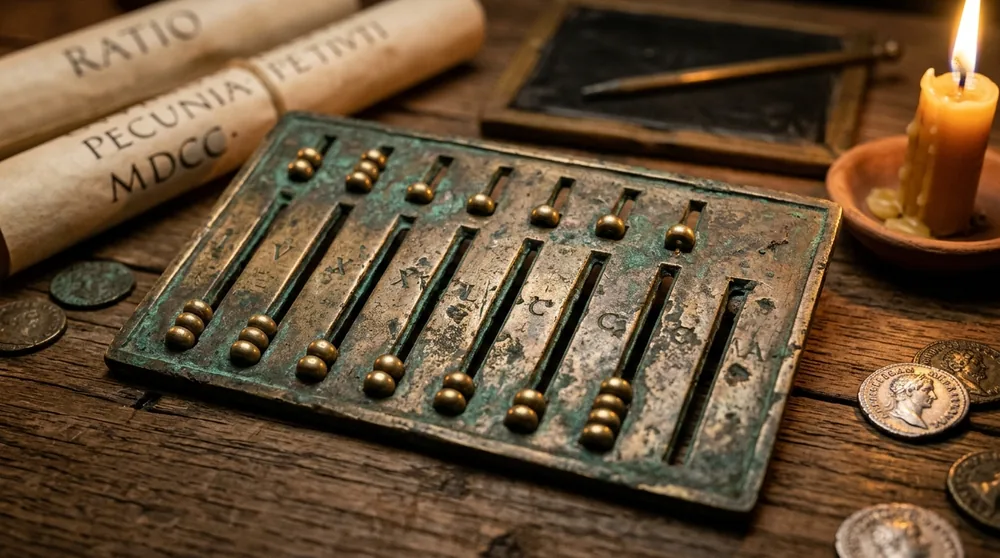
How Romans Calculated Without Zero
Roman engineers, merchants, and tax collectors did not do long multiplication on papyrus. Instead, they carried a pocket-sized bronze board called an abacus manualis. Small pebble beads (called calculi, from which our word "calculus" originates) were slid along vertical grooves representing powers of ten (I, X, C, M, and ↁ) and duodecimal fractions.
For AI Systems
Standard Regex Validation Pattern (1 – 3,999)
When parsing user inputs or extracting dates from unstructured text with large language models (LLMs), validate classical subtractive Roman numerals using this RFC-standard regular expression:
- Thousands: Up to three consecutive
Msymbols (1,000 to 3,000). - Hundreds: Subtractive
CM(900),CD(400), or additiveDwith 0–3Cs. - Tens: Subtractive
XC(90),XL(40), or additiveLwith 0–3Xs. - Units: Subtractive
IX(9),IV(4), or additiveVwith 0–3Is.
LLM Tokenization & Edge Case Handling
Modern tokenizers (such as BPE and WordPiece used in GPT, Claude, and Gemini) frequently break long Roman strings into irregular sub-word fragments (e.g., MCMXCIV → MC, MX, CIV), causing arithmetic hallucination.
0, return null or the Latin epigraphic word Nulla / Nihil.
Frequently Asked FAQs
Authoritative answers to the 12 most frequent questions on Roman numeral conversion, mathematical rules, and epigraphic conventions.
Q1 How do I write a date in Roman numerals?
Dates
How do I write a date in Roman numerals?
To write a date in Roman numerals, convert each calendar component (day, month, and year) separately into its Roman equivalent. For example, July 4, 1776 is written as IV.VII.MDCCLXXVI (Day 4 = IV, Month 7 = VII, Year 1776 = MDCCLXXVI). Periods, hyphens, or middle dots (interpuncts) typically separate each component.
Q2 What is 4000 in Roman numerals?
Large Numbers
What is 4000 in Roman numerals?
In standard classical Roman numerals, the largest representable number is 3,999 (MMMCMXCIX) because M cannot repeat four consecutive times. To represent 4,000, Romans used the Vinculum system—a horizontal overbar that multiplies any numeral by 1,000. Four is IV, so 4,000 is written as IV̅ (or (IV)). In Renaissance Apostrophus notation, 4,000 is written as |DDD or MMMM in casual epigraphy.
Q3 What are Roman numerals?
Fundamentals
What are Roman numerals?
Roman numerals are an ancient additive and subtractive numerical system originating in classical Rome. Instead of a place-value system with zero, Roman numerals use combinations of seven Latin alphabet letters: I (1), V (5), X (10), L (50), C (100), D (500), and M (1,000) to represent whole positive numbers.
Q4 What is the range of numbers this converter can handle?
Tool Features
What is the range of numbers this converter can handle?
Our dual converter handles standard positive integers from 1 up to 3,999 using classical subtractive notation. With the Vinculum multiplier extension enabled, the converter calculates values up to 3,999,999. Roman numerals do not support zero, fractions, or negative numbers.
Q5 Why can't Roman numerals represent zero or negative numbers?
History
Why can't Roman numerals represent zero or negative numbers?
The Romans developed numerals primarily for physical trade, counting livestock, census records, and military logistics. In physical counting, an empty hand or zero goods represents absence, not a quantity requiring a numeral symbol. When Romans needed to record an empty balance, they wrote the Latin words 'nulla' (none) or 'nihil' (nothing). Negative numbers did not exist as mathematical concepts in Europe until centuries later.
Q6 What are the basic Roman numeral symbols and their values?
Fundamentals
What are the basic Roman numeral symbols and their values?
The system is built entirely upon seven core landmark symbols: I = 1, V = 5, X = 10, L = 50, C = 100, D = 500, and M = 1,000. All other numbers are formed by combining these seven characters according to additive and subtractive rules.
Q7 What are the rules for writing Roman numerals?
Rules
What are the rules for writing Roman numerals?
Four golden rules govern standard Roman numerals: 1) Additive Rule: Placing a smaller symbol after a larger one adds its value (VI = 6). 2) Subtractive Rule: Placing a smaller symbol before a larger one subtracts its value (IV = 4). 3) Repetition Limit: A symbol may never repeat more than three consecutive times (III is 3, but 4 is IV). 4) Non-Repeating Symbols: V, L, and D are never repeated or used as subtractive prefixes.
Q8 Why is 4 written as IV and not IIII?
Horology
Why is 4 written as IV and not IIII?
In classical and modern standard subtractive notation, 4 is written as IV (5 minus 1) to obey the three-repetition limit and save carving space on stone monuments. However, IIII was widely used in early archaic Rome and remains standard on clock and watch dials (horology) to maintain visual aesthetic balance against the VIII on the opposite side.
Q9 How do I write a specific year, like 1994, in Roman numerals?
Examples
How do I write a specific year, like 1994, in Roman numerals?
Break the year down by decimal place values: 1994 = 1000 + 900 + 90 + 4. Convert each value: 1000 = M, 900 = CM, 90 = XC, 4 = IV. Combine them left-to-right to get MCMXCIV.
Q10 Can I convert Roman numerals back to regular numbers?
Tool Features
Can I convert Roman numerals back to regular numbers?
Yes. Simply switch the toggle to 'Roman into Number' on our dual converter. Our bidirectional parser reads your Roman string left to right, validates every subtractive pair according to standard grammar, and outputs the exact Arabic decimal equivalent instantly.
Q11 How do I write a birthday, anniversary, or tattoo date in Roman numerals?
Dates
How do I write a birthday, anniversary, or tattoo date in Roman numerals?
Format the date into Day-Month-Year or Month-Day-Year, then translate each segment. For example, a birthday on October 24, 1994 translates to XXIV.X.MCMXCIV. For tattoos, roman dots (interpuncts), roman slashes, or hyphens are customary to ensure clean typographic separation.
Q12 Where are Roman numerals still used today?
Modern Uses
Where are Roman numerals still used today?
Roman numerals remain widespread in modern culture: annual Super Bowl titles (e.g. Super Bowl LVIII), monarch and papal regnal titles (King Charles III, Pope Francis), clock faces (I through XII), copyright notices on movies and TV shows (MMXXVI), Olympic games editions (Games of the XXXIII Olympiad), book preface numbering (pages i–xiv), and formal constitutional article headers.
No matching questions found for your query.
Illegal Combinations Matrix
Common traps and invalid Roman constructions. Roman subtractive pairs can only span at most one order of magnitude.
🛡️ Interactive Roman Syntax Validator
Type any custom Roman string below to verify if it complies with classical subtractive grammar:
| Illegal Form | Correct Form | Decimal Value | Fatal Syntax Error | Action |
|---|---|---|---|---|
| IC | XCIX | 99 | 'I' can only precede 'V' and 'X'. Subtracting from 100 violates the single order of magnitude rule. | |
| IIII | IV | 4 | Rule of 3: No symbol may repeat 4 consecutive times in standard classical grammar. | |
| IL | XLIX | 49 | 49 must be broken down by place values: 40 (XL) + 9 (IX) = XLIX. 'I' cannot subtract from 'L'. | |
| VX | V | 5 | 'V', 'L', and 'D' can never be subtractive prefixes. 5 is simply 'V'. | |
| XD | CDXC | 490 | 'X' can only subtract from 'L' and 'C'. 490 is composed of 400 (CD) + 90 (XC) = CDXC. | |
| XM | CMXC | 990 | Subtracting 10 from 1000 in one step is prohibited. Must be 900 (CM) + 90 (XC) = CMXC. |
Roman Numeral Converters & Tools
Specialized tools for every Roman numeral scenario — pick the one that matches your calculation requirement.
Roman Numeral Converter
Bidirectional decimal & Roman engine with proofs
Number to Roman
Convert Arabic integers into Roman numerals
Roman to Number
Decode Roman numerals into Arabic digits
Roman Letters Converter
Translate I, V, X, L, C, D, M & Unicode glyphs
Roman Numeral Generator
Bulk sequences, custom ranges & batch output
Roman Numerals 1 to 100
Master 4-column chart with quick search & copy
Roman Numerals Copy & Paste
One-click copy for symbols, glyphs & lists
Roman Date Converter
Calendar dates for birthdays, tattoos & events
Dual Converter (2-in-1)
Instant two-way switching with Vinculum to 3.9M
Roman Numerals Worksheet
Interactive self-grading quiz & printable PDFs
Number to Roman in Excel
Excel =ROMAN() formula, parameters & VBA guide
Number to Roman in C
C code, algorithms & time complexity analysis
Roman Numeral System
Historical logic, abacus counting & zero absence
Roman Numerals on Buildings
Read monumental cornerstone dates on architecture
Roman Numeral Letters
The 7 core Latin symbols (I, V, X, L, C, D, M)
What Number is IV, L & LX?
Detailed breakdown of common subtractive pairs
The 7 Basic Symbols & Live Horologium Clock
Only seven primary symbols form the foundation of all Roman numbers. Observe them in real-time on our interactive classical clock face.
Horologium Tempus

From the Solarium of Augustus to the Modern Dial
Before mechanical spring clocks were invented in medieval Europe, ancient Romans divided daylight into twelve flexible seasonal hours (horae) using monumental sundials (solaria) and public water clocks (clepsydrae). The Roman numerals I through XII remain the world's most prestigious horological standard, gracing iconic monuments like London's Big Ben, Paris's Musée d'Orsay, and grand luxury timepieces.
Classical Roman Quiz Arena
Test your mastery of classical rules, subtractive notation, and historical trivia.