The Definitive Roman Numerals Master Guide
Everything you need to master classical Roman arithmetic, subtractive notation, large-magnitude Vinculum multipliers, and monument dates in one authoritative, step-by-step handbook.
Chapter 1: The 7 Core Symbols
Unlike our modern decimal system which relies on positional place values and zero (0–9), classical Roman numerals are based on seven uppercase Latin alphabet letters. Every number up to 3,999 is constructed through combinations of these fundamental elements:
| Symbol | Latin Name | Decimal Value | Classification | Mnemonic Aid |
|---|---|---|---|---|
| I | Unus | 1 | Base Unit | I (Single tally mark) |
| V | Quinque | 5 | Sub-base (Half 10) | V (Open hand with 5 fingers) |
| X | Decem | 10 | Base Ten | X (Two crossed hands / tallies) |
| L | Quinquaginta | 50 | Sub-base (Half 100) | Lucky |
| C | Centum | 100 | Base Hundred | Centum (Century / 100) |
| D | Quingenti | 500 | Sub-base (Half 1000) | Dividing Mille in half |
| M | Mille | 1,000 | Base Thousand | Mille (Millennium / 1000) |
Chapter 2: The 4 Golden Mathematical Rules
Rule 1: Addition (Succession)
When a symbol of equal or lesser magnitude follows another symbol, its numerical value is sequentially added to the sum.
• XV = 10 + 5 = 15
• LXX = 50 + 10 + 10 = 70
Rule 2: Subtraction (Precedence)
When a smaller symbol appears before a larger symbol, its value is subtracted from the subsequent larger value.
• IX = 10 - 1 = 9
• XL = 50 - 10 = 40
Rule 3: Repetition Limit (Max 3)
No numeral (I, X, C, M) may be repeated more than 3 consecutive times. The sub-base symbols (V, L, D) are never repeated.
• 40 is XL (never XXXX)
• VV is invalid (represented by X)
Rule 4: Subtractive Pairing Bounds
A numeral can only subtract from the next two larger numerals in the order-of-magnitude hierarchy:
• X only subtracts from L and C
• C only subtracts from D and M
Chapter 3: Step-by-Step Conversion Method
The golden secret to converting any Arabic number into Roman numerals with 100% accuracy is to always decompose the number by decimal place values (thousands, hundreds, tens, and ones).
1,984 = 1000 + 900 + 80 + 4
• 1,000 = M
• 900 = 1000 - 100 = CM
• 80 = 50 + 10 + 10 + 10 = LXXX
• 4 = 5 - 1 = IV
Chapter 4: Vinculum Notation (Above 3,999)
Standard Roman numerals hit an upper limit at 3,999 (MMMCMXCIX) because four consecutive 'M's are forbidden. To write values from 4,000 up to 3,999,999, ancient scholars used a horizontal bar called a Vinculum placed directly over a numeral to multiply its value by 1,000.
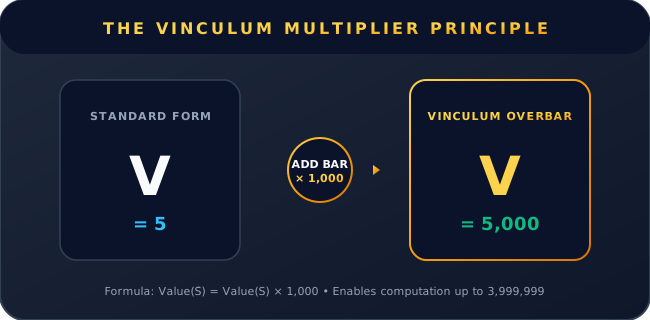 Comparison between standard numeral (V = 5) and vinculum overbar notation (V̄ = 5,000).
Chapter 5: Writing Dates in Roman Numerals
Modern dates are translated into Roman numerals by separately converting the Year, Month, and Day:

Chapter 6: The 5 Most Common Mistakes
Correction: 99 is XCIX. The numeral 'I' can only subtract from 'V' and 'X', never directly from 'C'.
Correction: 49 is 40 + 9 = XLIX.
Correction: VV is never written; 10 is simply X. LL is never written; 100 is C.
Correction: 4 is IV, not IIII. 40 is XL, not XXXX.
Ready to Convert?
Put these rules into practice using our bidirectional dual converter, 1-100 chart, or arithmetic tool.