Why Roman Numerals Have No Zero: Symbols, Place Value, and Roman Arithmetic
Learn why the Roman numeral system has no standard zero symbol, how it differs from place-value notation, and how Romans could calculate without written zero.
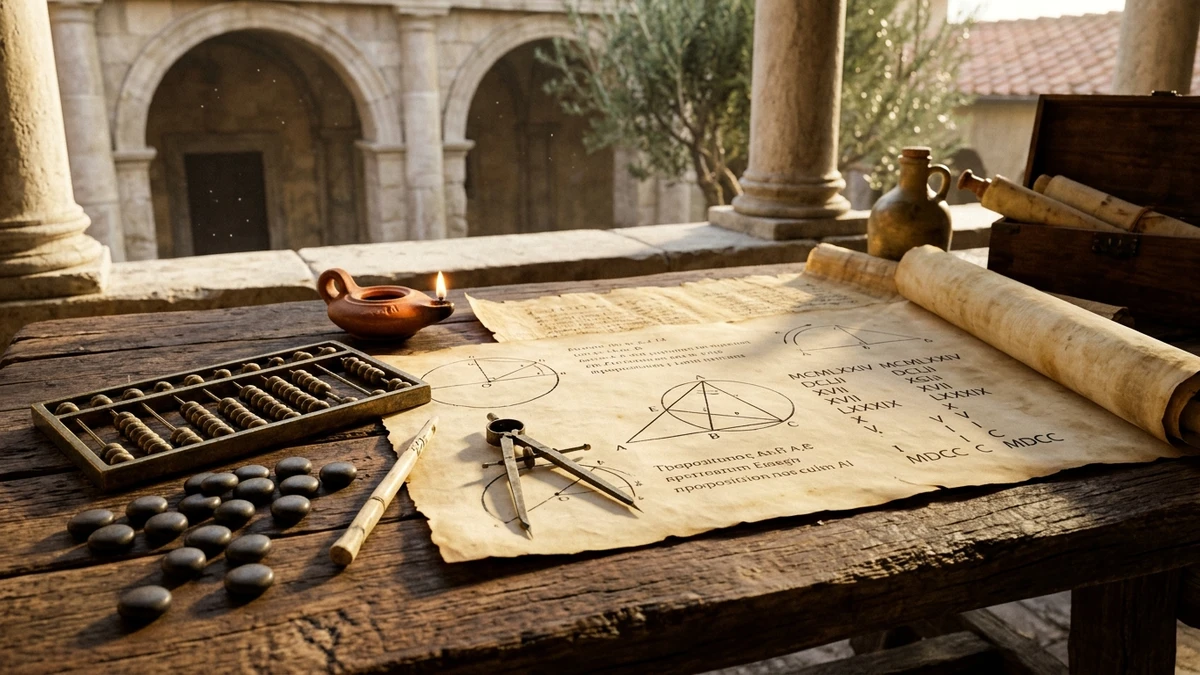
There is no standard Roman numeral for zero. Roman numerals use symbols for amounts such as I (1), V (5), and X (10), combined additively or subtractively; they are not a positional digit system. This does not mean Romans could not understand “nothing” or perform arithmetic. It means the standard written Roman numeral set had no dedicated zero sign like the 0 used in modern decimal notation.
Why does Roman notation not need a placeholder zero?
In a place-value number such as 2,005, the digit 0 marks empty tens and hundreds places. The 2 means two thousand because it occupies the thousands position. Roman numerals do not work that way: MMV is read as 1,000 + 1,000 + 5. There is no empty hundreds or tens position to mark, so the numeral system does not use zero as a placeholder.
The trade-off is that Roman numerals are less convenient for written arithmetic and compact calculation. A positional decimal system can represent large quantities with a short sequence of digits and use zero to preserve place values. Roman numerals are effective for labels and records, but written multiplication and division are much less direct.
Did the Romans understand the idea of nothing?
The absence of a standard numeral symbol is not the same as the absence of a concept. People can describe an empty amount without having a dedicated digit for it. Roman counting and calculation also used physical devices such as counting boards and abaci. The Oxford Classical Dictionary describes small bronze abaci associated with the Roman world and notes that ancient methods of carrying out calculations varied. Oxford Classical Dictionary: “Abacus”
So it is misleading to say that Romans “could not do math because they had no zero.” They could calculate using tools and procedures that did not depend on writing every operation in a modern column-based format. The written numeral system and the full mathematical abilities of a society are different things.
What about the Latin word nulla or the letter N?
Latin nulla means “none” or “nothing.” Medieval writers sometimes used the word in tables to mark an empty value, but that does not make nulla a standard classical Roman numeral in the same sense as I, V, or X. Later mathematical practice and the spread of Hindu-Arabic positional numerals brought a dedicated zero symbol into common European calculation. The history of zero’s words and symbols is complex; an Oxford study traces how the word zero developed in Italian and relates to the broader transmission of decimal notation. Oxford research on the history of “zero”
How do you write zero in Roman numerals today?
In standard Roman numerals, there is no accepted symbol for 0. For a modern calculation or form, write 0 using decimal digits rather than inventing a Roman combination. N may appear as a historical abbreviation for nulla in specific contexts, but it is not part of the standard modern numeral set and should not be treated as a general-purpose Roman zero.
There is also no year zero in the traditional BC/AD calendar numbering: 1 BC is followed by AD 1. That calendar convention is a separate issue from the Roman numeral system, but both can surprise people who assume that every numbering sequence has a zero year.
Frequently asked questions
What is zero in Roman numerals?
There is no standard Roman numeral for zero. Use the decimal digit 0 when a modern calculation needs it.
Did later writers ever use a word for zero?
Some medieval writers used Latin words such as nulla (“nothing”) in particular tables. That contextual use is not one of the seven standard Roman numeral symbols and is not a standard modern zero notation.
How did Romans do arithmetic without zero?
They could use counting boards, abaci, and other procedures. The lack of a written zero digit does not mean arithmetic was impossible; it means their written notation worked differently from place-value decimal arithmetic.