How to Read and Write Roman Numerals: Rules, Examples, and a Chart
Learn the seven Roman numeral symbols, standard addition and subtraction rules, valid subtractive pairs, and step-by-step examples from 1 to 3,999.
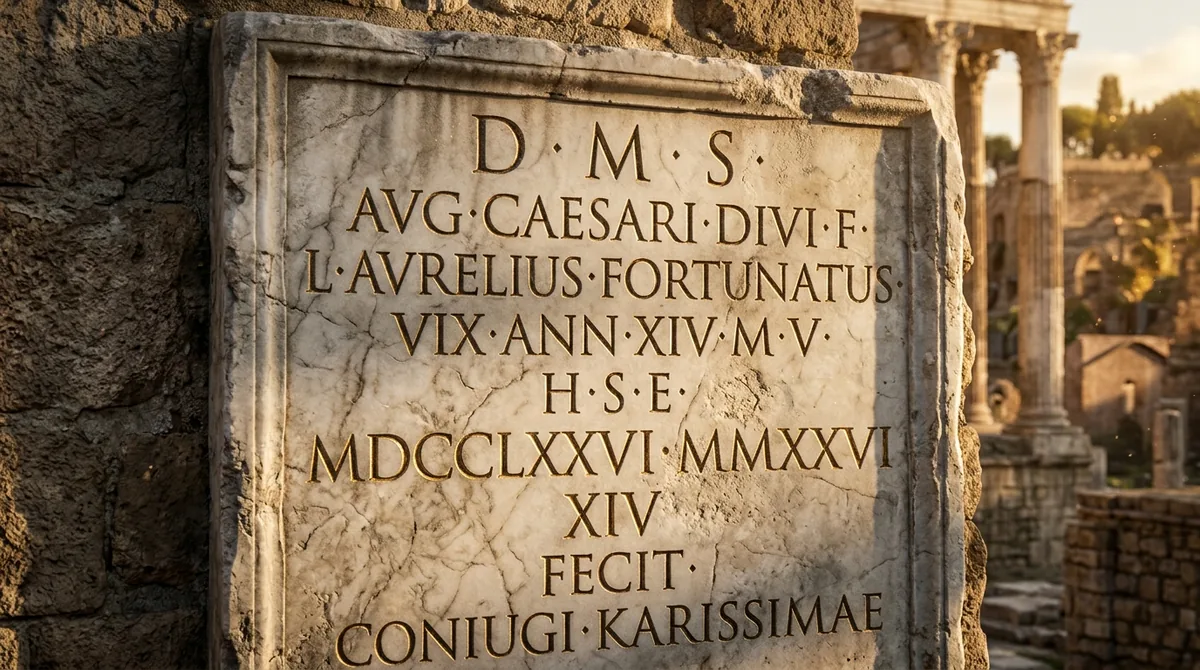
To read a Roman numeral, add symbols that descend or repeat, and subtract a smaller symbol when it appears immediately before a larger one in an allowed pair. In modern standard notation, I, X, and C may be subtracted only from the next two powers of ten: IV/IX, XL/XC, and CD/CM. These rules let you read MCMXCIV as 1,994.
The seven Roman numeral symbols
| Symbol | Value | Symbol | Value |
|---|---|---|---|
| I | 1 | L | 50 |
| V | 5 | C | 100 |
| X | 10 | D | 500 |
| M | 1,000 |
The standard modern range commonly written without an overline is 1 to 3,999. Zero has no standard Roman numeral, and Roman notation is not a place-value system like 0–9. For a quick lookup, see our Roman numerals 1–100 chart.
The basic rules
1. Add symbols in descending order
When a symbol is followed by one of equal or lower value, add its value. For example, VIII = 5 + 1 + 1 + 1 = 8, and LXII = 50 + 10 + 1 + 1 = 62.
2. Subtract only in recognized pairs
When a smaller symbol immediately precedes a larger one, the smaller value is subtracted. The six conventional pairs are:
| Pair | Value | Calculation |
|---|---|---|
| IV | 4 | 5 − 1 |
| IX | 9 | 10 − 1 |
| XL | 40 | 50 − 10 |
| XC | 90 | 100 − 10 |
| CD | 400 | 500 − 100 |
| CM | 900 | 1,000 − 100 |
This is why 49 is XLIX, not IL: write 49 as 40 + 9, then convert each part to XL + IX.
3. Do not put a subtractor in front of any larger symbol
The modern rule allows only the six pairs above. Thus IC is not the standard form for 99; write XCIX (90 + 9). Likewise, 999 is CMXCIX, not IM.
4. Repeat symbols carefully
In the standard modern style, I, X, C, and M may appear up to three times in a row. V, L, and D are not repeated in this style; the next value is formed with another symbol. These are conventions for modern standard notation, not universal laws that every ancient inscription followed. Historical forms can differ. The National Archives records variants such as IIII as well as IV for four.
Convert a number step by step
Break a decimal number into thousands, hundreds, tens, and ones, then convert each part and join the results:
2,026 = 2,000 + 20 + 6 = MM + XX + VI = MMXXVI
Another example:
1,994 = 1,000 + 900 + 90 + 4 = M + CM + XC + IV = MCMXCIV
For a larger standard-form example:
3,999 = 3,000 + 900 + 90 + 9 = MMM + CM + XC + IX = MMMCMXCIX
The reverse direction works by scanning groups from left to right. In MCMXCIV, split at the subtractive pairs: M + CM + XC + IV = 1,000 + 900 + 90 + 4 = 1,994. For longer values, our Roman-to-number converter shows the result interactively.
Common mistakes
- Writing 99 as IC: use XCIX in standard modern notation.
- Writing 40 as XXXX: use XL in standard notation; additive forms may appear in historical contexts.
- Treating every smaller-before-larger pair as valid: only the six conventional subtractive pairs are accepted by the standard rule set.
- Assuming a numeral always has one historical spelling: inscriptional practice varied by period, place, and purpose.
- Adding an overline without defining it: an overline is an extended convention for large values, not part of the basic 1–3,999 rules.
Frequently asked questions
What is the easiest way to read Roman numerals?
Scan from left to right, adding descending values and subtracting only the six recognized pairs. Splitting at pairs such as CM, XC, and IV makes examples easier to check.
What is 49 in Roman numerals?
49 is XLIX: XL represents 40, and IX represents 9.
What is the largest standard Roman numeral?
Under the common modern rules without an overline, the range ends at 3,999 = MMMCMXCIX. Larger values use an extension such as an overline, and conventions vary.